
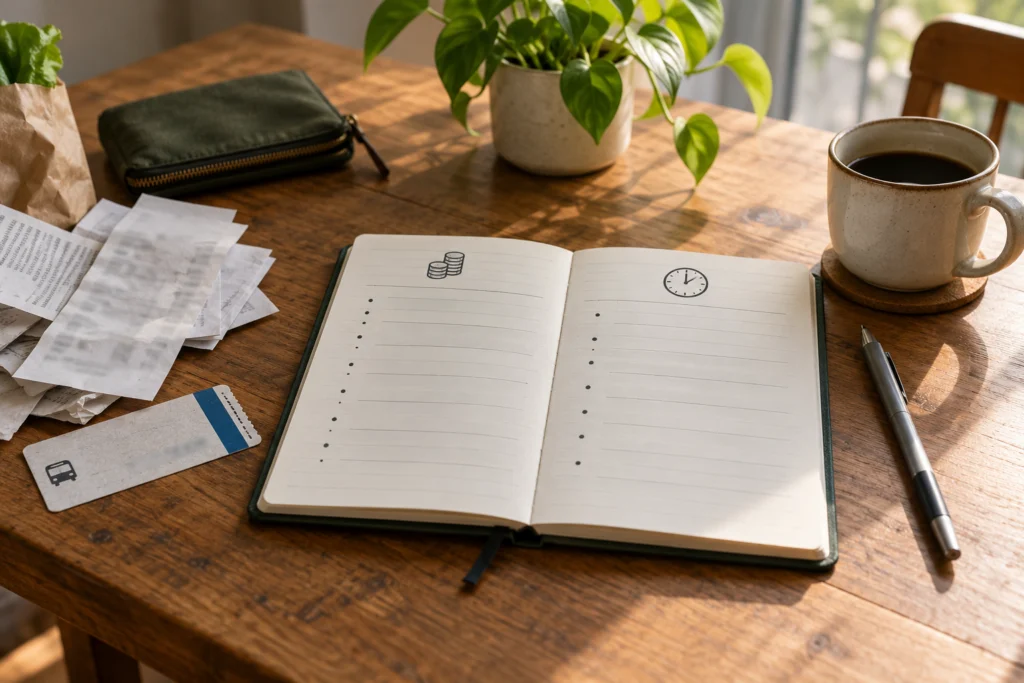
A spending diary can explain where money went while missing the effort needed to obtain the purchase or service. Adding a small time column reveals another part of the decision. Keep money and time distinct so neither disappears into a misleading single total.
Choose a manageable observation period
Select a few representative days or one recurring activity. Record the cash amount, purpose and time needed for travel, waiting or preparation. You do not need to document every minute of life to learn something useful.
Mark shared or overlapping time. A shopping trip combined with a necessary journey should not automatically be assigned its entire duration twice. Explain the method simply.
| Field | Record | Use |
|---|---|---|
| Money | Final amount and relevant charges | Cash budget |
| Time | Travel, waiting and preparation | Practical commitment |
| Purpose | What need or activity was served | Meaningful comparison |
| Context | Shared trip or unusual delay | Avoids false precision |
Compare choices with the same purpose
A cheaper shop may require a longer journey. A delivered service may cost more but change the time needed. Neither is automatically better; the diary makes the trade-off visible for the household to decide.
Do not assign everyone’s time one invented wage and present it as an actual expense. If you use a valuation for a particular analysis, label the assumption and keep the original hours available.
- Keep cash and time in separate columns.
- Use a limited period tied to a real question.
- Mark overlap and unusual conditions.
- Review the pattern before collecting more detail.
Turn the diary into a practical change
The useful action may be combining suitable trips, changing frequency or choosing a service that better fits the week. Avoid optimising a tiny purchase while ignoring a much larger recurring commitment.
A diary is information, not a moral score. Some spending is chosen for enjoyment or convenience. Explain those priorities honestly and check that the total remains compatible with essential commitments. Mark estimated durations explicitly, so a remembered journey does not acquire the same apparent precision as a timed observation.
Questions and answers
Does more time always mean a worse choice?
No. The activity may itself be enjoyable or serve another purpose. Keep context in the record.
Should I convert every hour into dollars?
Not necessarily. Separate hours and cash often describe the trade-off more honestly.
How long should the diary continue?
Long enough to answer the chosen question. Stop or simplify when extra detail no longer changes the decision.
Sources: canada.ca.