
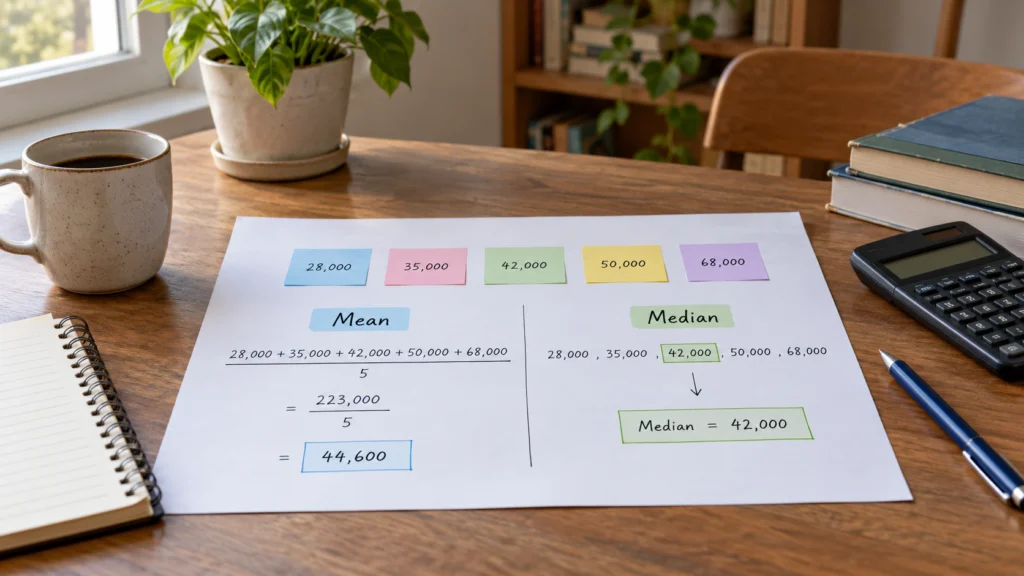
A headline about average income can be mathematically correct while failing to describe the household in the middle. The word “average” is often used loosely. Ask which measure is reported and who is included before turning it into a claim about a typical life.
Mean and median answer different questions
The arithmetic mean adds the values and divides by their number. The median is the middle value after ordering them. A small number of very large values can pull the mean upward without moving the middle household by the same amount.
Consider five fictional annual household incomes of $30,000, $35,000, $40,000, $45,000 and $350,000. Their mean is $100,000 and their median is $40,000. These numbers are an invented teaching example, not Canadian income data.
| Question | Check | Possible misunderstanding |
|---|---|---|
| Which average? | Mean or median | One is assumed to stand for the other |
| Whose income? | Individuals, households or another unit | Different populations are mixed |
| Which definition? | Before or after tax and included sources | Unlike amounts are compared |
| Which period? | Year and price basis | Changes in time are ignored |
Keep household composition visible
A total household income does not by itself describe the number of people supported. A comparison may use an adjustment or may not. Read the source definition instead of inventing one.
The distribution also matters. Two populations can share a mean while having very different spreads. A single figure cannot describe every experience of affordability or financial strain.
- Find the source’s exact measure.
- Check the population and income definition.
- Keep examples clearly separate from observed data.
- Avoid using a headline average to judge an individual household.
Use a statistic for the question it can answer
A mean can be useful for some aggregate comparisons, while a median helps locate the middle observation. Neither is automatically the best answer to every policy or household question. Explain why the chosen measure fits the analysis.
For a personal budget, use actual household resources and obligations. A national figure does not tell you what a particular family can afford, and being above or below it is not a financial plan.
Questions and answers
Is the mean always wrong when incomes are unequal?
No. It answers a particular arithmetic question. The problem is treating it as a complete description of the middle household.
Does median mean most households earn exactly that amount?
No. It identifies the middle position in the ordered distribution, not the most common exact value.
Are the five incomes here real statistics?
No. They are explicitly fictional values used to demonstrate the calculation.