
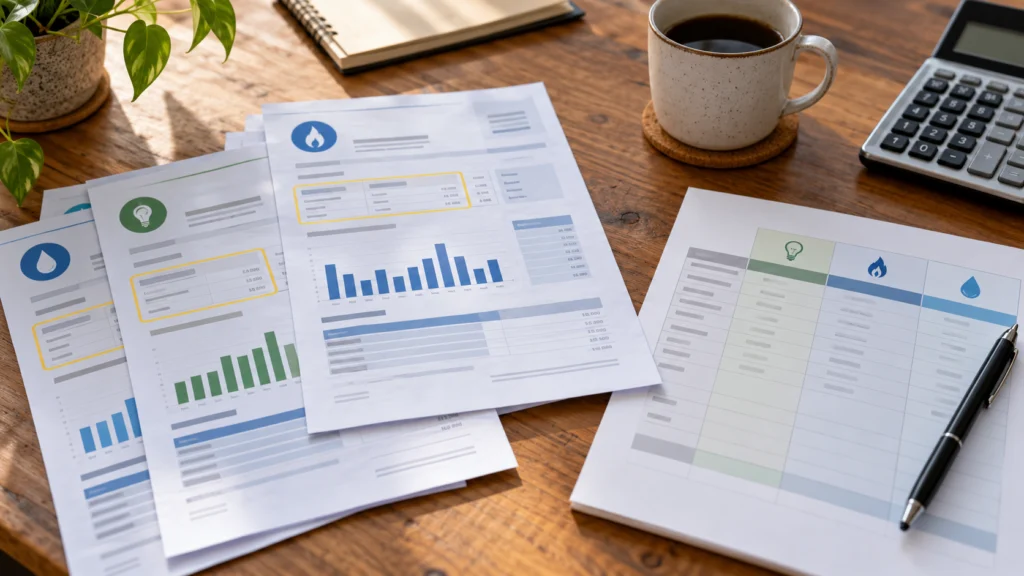
A utility bill is not a simple score for a home’s efficiency. It combines use, prices, fixed charges and a billing period. Different households and buildings can produce different totals for several reasons. Start by making the measures comparable.
Check what each bill includes
Record the service, dates, units and whether the reading is actual or estimated where stated. A longer billing period can create a larger total without higher daily use. A combined bill may include services absent from another quote.
Keep fixed charges, consumption charges and taxes or other applicable items distinct. Use the provider’s current explanation for unfamiliar lines rather than guessing from the total.
| Item | Check | Why |
|---|---|---|
| Period | Number of days and season | Use changes with time and conditions |
| Consumption | Comparable units | Cost and quantity are different |
| Price structure | Fixed and variable charges | A lower total may reflect a different tariff |
| Household context | Occupancy and ordinary use | Buildings are not the only source of variation |
Do not infer a building diagnosis from one bill
Size, exposure, equipment and use can affect the result. A large bill may justify investigation but does not identify the cause by itself. Ask a qualified building or energy professional where a technical assessment is needed.
Compare several relevant periods if available and note major changes. A new resident, changed work pattern or equipment fault can make a simple before-and-after comparison misleading.
- Use the same units and a comparable period.
- Separate consumption from price.
- Mark estimates and missing information.
- Seek qualified assessment before making technical alterations.
Use the comparison for a practical decision
For housing choices, ask what is included in rent and what the household must pay separately. For an existing home, identify the question the data can support: a billing enquiry, a usage review or a professional assessment.
Do not weaken ventilation, heating safety or other building functions to make a bill smaller. Cost management should work within appropriate equipment instructions and qualified advice. A lower number is not useful if it conceals a new problem.
Questions and answers
Does the lowest bill prove the most efficient home?
No. Household use, period and prices can differ. A technical efficiency assessment needs more information.
Should I compare dollars or units?
Both, separately. Units describe consumption while dollars also reflect the price structure.
Can an estimated reading be treated as exact use?
Mark it as estimated and follow the provider’s process for clarification or later reconciliation.
Sources: canada.ca.